
Reviewed · MONASTERIES & PAINTED CHURCHES
Day trip from Iasi to the UNESCO Painted Monasteries in Bucovina
Color that refuses to fade. This Iasi day trip takes you to Bucovina’s UNESCO-painted churches, where frescoes still glow and a guide makes the stories easy to follow.
I especially liked the hotel pickup convenience and the small group size, because you get real time to ask questions. I also liked the mix of major murals at Voronet, Moldovita, Sucevita, plus the practical stop in Marginea for black pottery.
One thing to plan for: it’s about a 12-hour day with a bit of walking, and lunch is not included.
In This Review
- Key highlights you should care about
- From Iasi at 8:00 am: How the day actually runs
- Entering Voronet Monastery: The story behind the famous murals
- Moldovita’s painted Bible: Why the murals mattered for everyday people
- Sucevita’s green walls: Gothic and Byzantine mix in paint
- Marginea black pottery: A craft stop you can actually picture
- The guide makes the murals make sense (and names you might get)
- Price and value at $244.57: what you get for the money
- Practicalities that matter: walking, time, and weather
- Should you book this Painted Monasteries day trip from Iasi?
- FAQ
- What time does the Iasi pickup happen?
- How long is the day trip?
- Are entrance fees included for the monasteries?
- Is lunch included in the tour price?
- How big is the group?
- What happens if the weather is bad?
Key highlights you should care about
- Three UNESCO churches in one route: Voronet, Moldovita, Sucevita, with entry fees handled.
- Frescoes explained in plain English: you will not just see paintings, you will understand what they show.
- Marginea black pottery stop: a working craft stop, not a museum-style detour.
- Hotel pickup and drop-off: you start in Iasi at 8:00 am and return the same day.
- Small group, maximum 7 people: more personal attention from your guide.
- Modern vehicle plus bottled water: the drive is part of the comfort, not a punishment.
More painted monasteries:
- Three days tour of Iasi and UNESCO Painted Monasteries★ 5.0 · 2 reviews
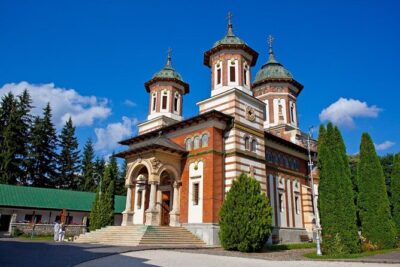
- 3-Castle: Peles,Bran,Rasnov,Sinaia Monastery from Brasov w pickup★ 5.0 · 274 reviews
- Bucovina Painted Monasteries Day Tour★ 5.0 · 83 reviews
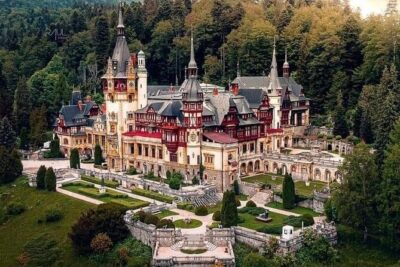
- Peles Castle, Bran Castle, Rasnov Fortress and Sinaia Monastery Tour from Brasov★ 5.0 · 55 reviews
From Iasi at 8:00 am: How the day actually runs
This is built as a true day trip. The start time is 8:00 am, and pickup is from any hotel in Iasi. Expect about 12 hours total, which means an early morning, a full slate of stops, and a return later that evening.
The itinerary is structured around three major painted monasteries, with enough time at each place to slow down and read the murals. You also get bottled water, and you travel by a modern vehicle. That matters because Bucovina is not right next door, and you will feel the day in your feet if you underestimate the timing.
What to pack is simple: comfortable shoes for a small amount of walking, sun protection, and a layer for inside church spaces that can feel cooler. Also, since lunch is not included, decide ahead of time whether you want to eat during the tour’s free time or add your own stop so you are not rushing.
Finally, plan around weather. This experience requires good weather, and if it has to be canceled for poor conditions, you get offered another date or a full refund.
Entering Voronet Monastery: The story behind the famous murals
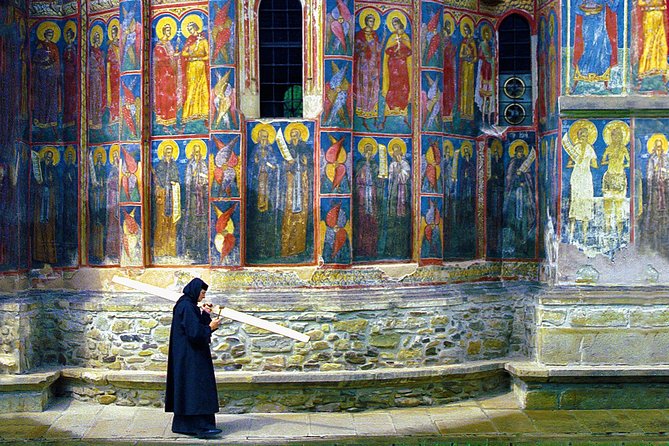
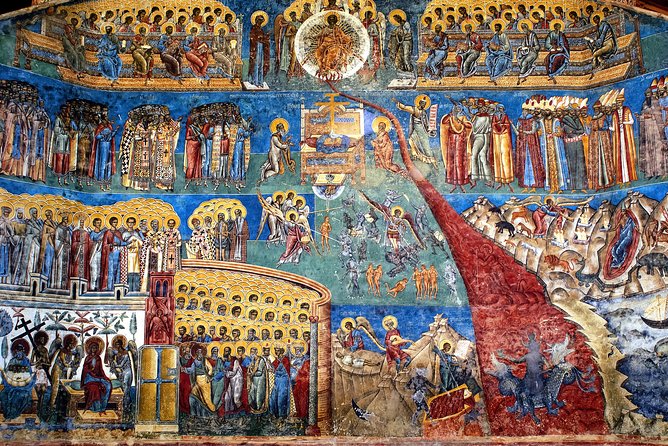
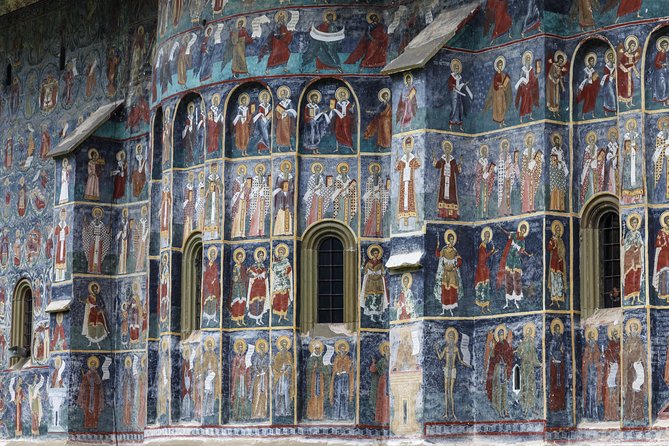
Voronet is the first stop, and it is one of the easiest places to fall in love with Bucovina. The monastery was built in 1488 in record time: three months, three weeks, and three days. Today, it is part of the UNESCO heritage, and the exterior murals still hold their hue after centuries of weather.
The big reason Voronet feels special is that the painted scenes read like a sequence, almost like a movie. You will see Christianity’s history presented in a folk-influenced way, shaped by Eastern culture and Orthodox thought. A good guide can help you connect those scenes to what is happening in the community around the church, not just treat them like decorative art.
The tour time here is about 1 hour, and admission is included. That is enough time to walk the exterior views slowly, then step inside and compare the message of the paintings in context.
A practical note: exterior murals can be easier to appreciate from the right angle, so if you care about photos, take your time and do not rush your first look. If you try to do everything in ten minutes, you will miss the way the imagery tells a coherent story.
Moldovita’s painted Bible: Why the murals mattered for everyday people
Next comes Moldovita, included in the UNESCO heritage since 1993. It was built between 1532 and 1537, and the murals are the main event. This is where the churches stop feeling like “pretty buildings” and start feeling like communication tools.
The murals were, for hundreds of years, one of the key ways uneducated country dwellers could learn Bible teachings. Think of it as visual education in a time when written access was limited. The frescoes are described as a huge color presentation of Biblical scenes, adapted to the local history and to important moments in the community’s life.
You will get about 1 hour here, with admission included. The best way to get value in that time is to let your guide walk you through the “why” behind the scenes. When you understand what the imagery is pointing to, Moldovita feels more intentional, less random.
A possible drawback to keep in mind: if you only like art when it is the absolute biggest and brightest thing around, Moldovita may feel more “story heavy” than “shock factor.” But if you enjoy symbolism and meaning, this is often the stop that clicks hardest.
Other Iasi days worth the drive
Sucevita’s green walls: Gothic and Byzantine mix in paint
Sucevita is the newest of the Painted Monasteries of Bukovina and also part of the UNESCO heritage since 1993. Built in the Moldavian style with Gothic and Byzantine influences, it is a different mood than Voronet.
The murals are dominated by green, and that green came from an ancient technique using natural pigments. That detail is small, but it changes how you look at the church. Instead of only noticing colors as decoration, you start thinking about how artisans achieved those shades and kept them enduring over centuries.
As with the others, you will have about 1 hour and admission is included. This timing keeps the day moving, but you can still take your time with the most striking panels if your guide gives you a route to follow.
If you are the kind of visitor who loves comparing churches side by side, Sucevita is a perfect capstone. You can look back and notice how each monastery’s murals lean into different themes and visual approaches, even though they all belong to the same UNESCO group.
Marginea black pottery: A craft stop you can actually picture
Between the painted church stops, you also go to Marginea to learn how black pottery is produced by craftsmen. This is a big reason the day trip feels more complete than just “three churches and done.”
Unlike the monasteries, which are built-in history, Marginea is about skills people still use. That means you get a chance to connect the region’s art tradition to something hands-on. Even if you cannot picture every step from the start, you will likely understand the overall process by the time you see the finished pottery style.
What you should watch for is how the craft looks simple from a distance but takes careful work up close. The black pottery is not just a color choice, it is part of the method and the final result. If you ask questions, your guide can help you bridge what you are seeing with how the artisans think about their work.
Because the exact time spent in Marginea is not specified here, treat it as a shorter, focused stop. Bring curiosity more than expectations. You are there to understand the craft, not to browse for hours.
The guide makes the murals make sense (and names you might get)
This tour is built around an English-speaking guide, and the structure is small enough for personalized attention. The maximum group size is 7 travelers, which keeps things from turning into a rushed, assembly-line day.
Different guides show up on different days. From past experiences, I have seen names like Mihai, Nicu (Niku), Iulian, and George. In one case, Florin joined to add extra humor and explanation, which is exactly what helps with dense symbolic murals.
A strong guide does two things for you:
1) They explain what you are looking at, in plain language.
2) They tell you why it matters to the people who built and used these churches.
That is why guides can dramatically change the experience. One person even compared the painted monasteries to the Sistine Chapel in terms of scale of artistic impact, and that reaction makes sense when a guide points out meaning rather than just pointing at walls.
You should also know that in some situations, guides may add small extras, like an adrenaline-leaning cable car ride over the woods, or steer you toward a very local lunch experience. Lunch itself is not included in the tour price, but the way guides help you find good food locally can still be part of the value.
Price and value at $244.57: what you get for the money
The price is $244.57 per person, and on paper it is not cheap for a day trip. In real terms, it can be good value because a lot of the big costs are wrapped in.
Included items are:
- Transportation in a modern vehicle
- An English-speaking guide
- Hotel pickup and drop-off
- Bottled water
- Entrance fees
That means you are not managing tickets, figuring out how to get between sites, or paying separate entrance costs while you are on the clock. You do not lose time negotiating transport either, since the day is organized for one continuous route.
Lunch is the main add-on. It runs about €15 per person in planning terms, and you will handle it yourself. If you already pay for separate admissions, private transfer, and a guide, you can see why the package can work out.
Group discounts are listed too, and with a maximum of 7 people, you get the advantage of a more intimate experience without the full cost of a one-on-one private tour.
Who this is best for: people who want a structured, guided introduction to UNESCO painted churches in Bucovina but do not want the stress of planning connections and timing between remote stops.
Practicalities that matter: walking, time, and weather
There is a small amount of walking in the day, so comfortable shoes are not optional if you want to enjoy the murals without turning it into a pain contest. The time at each monastery is about an hour, but you will still move around to see exterior angles and interior details.
This tour is also weather-dependent. Good conditions are required, because it is a road trip plus outdoor viewing for parts of the murals. If poor weather cancels it, you get offered a different date or a full refund.
If you are traveling with kids, they must be accompanied by an adult. A child rate applies only when sharing with 2 paying adults.
Finally, you get a mobile ticket. That means you should plan to have your phone charged and ready for whatever check-in instructions you receive after booking.
Should you book this Painted Monasteries day trip from Iasi?
Book it if you want the best version of a one-day introduction to Bucovina. You get all three UNESCO painted churches in one guided rhythm, plus Marginea black pottery, with hotel pickup and drop-off and entrance fees included. If you care about seeing art with meaning, not just taking pictures, the guided explanations are the difference-maker.
Skip it or rethink it if you hate long days, because it is about 12 hours and includes some walking. Also, if you are picky about lunch plans, budget time and money for food on your own since lunch is not included.
My decision rule is simple: if you want a full cultural highlight day without logistics stress, this is a strong fit. If you prefer slow travel and flexible pacing, you might enjoy staying longer in the region and splitting the churches across separate days.
FAQ
What time does the Iasi pickup happen?
The tour starts at 8:00 am, and pickup is from any hotel in Iasi.
How long is the day trip?
It runs for about 12 hours.
Are entrance fees included for the monasteries?
Yes. Entrance fees are included, along with bottled water.
Is lunch included in the tour price?
No. Lunch is not included, and it is listed at about €15 per person.
How big is the group?
The tour has a maximum of 7 travelers.
What happens if the weather is bad?
This experience requires good weather. If it is canceled due to poor weather, you will be offered a different date or a full refund.
Newest Iasi write-ups
- Adventure trip from Iasi: Hiking in the Carpathian Mountains
★ 5.0 · 2 reviews - Three days tour of Iasi and UNESCO Painted Monasteries
★ 5.0 · 2 reviews - Adventure day trip from Iasi | Hiking in the Carpathian Mountains
★ 5.0 · 10 reviews - Iasi City Tour
★ 5.0 · 12 reviews - Tour guide in Iasi, Romania
★ 4.9 · 14 reviews - Day trip to Republic of Moldova – visit Chisinau and Cricova Winery
★ 5.0 · 32 reviews
Monasteries & Painted Churches, compared.
3-Castle: Peles,Bran,Rasnov,Sinaia Monastery from Brasov w pickup
Read our review →
Peles Castle, Bran Castle, Rasnov Fortress and Sinaia Monastery Tour from Brasov
Read our review →
Princely Court of Târgoviște and Curtea de Argeș Monastery
Read our review →
Small Group Tour to Mogosoaia Palace & Snagov Monastery
Read our review →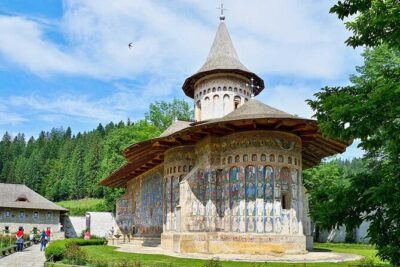
1-Day Bucovina Painted Monasteries tour from Suceava – English
Read our review →
Sacred Monasteries Private Tour: Snagov, Țigănești & Căldărușani
Read our review →
Transfagarasan Highway, Balea Lake & Carta Monastery
Read our review →Browse the lists this tour appears in