
Reviewed · COMMUNIST-ERA TOURS
Footprints of Bucharest: History, Communism & Urban Tales
Bucharest at night hits differently. This Footprints of Bucharest walk strings together communism-era turning points and grand city architecture under streetlights, so you get a clear story fast. I especially like the small group size for real back-and-forth questions, and I also like that the guide blends big events with human details, like Toni’s communist-era Christmas memories. One drawback to plan around: the tour depends on good weather, and you will be walking at a moderate pace for a few hours.
What makes this tour feel worth it is the mix of famous stops and quick detours that help you understand how Bucharest grew and why certain buildings became symbols. Guides you might meet, like Manuela, Marius, and Toni, are praised for clear English and for sharing local food and drink suggestions that help you keep exploring after the lights come on.
In This Review
- Key Points You Will Actually Care About
- Nighttime Bucharest That Makes the Past Feel Real
- Price and Timing for a 2 to 3 Hour Introduction
- Meeting at Strada Benjamin Franklin 2, Ending at Piata Unirii
- Ateneul Roman to Revolution Square: Symbols After Dark
- University Library, Royal Residence, and the Boulevard Between Eras
- Old Town Walk, Stavropoleos Monastery, and the Parliament Exterior
- Macca Villacrosse Passage to Lipscani: Arcades and Street Life
- Palatul CEC, Cărturești Carusel, and the Royal Museum Buildings
- Should You Book This Footprints of Bucharest Tour?
- FAQ
- How long is the Footprints of Bucharest tour?
- What is the maximum group size?
- Is the tour offered in English?
- Are entrance fees included?
- Where do I meet, and where does the tour end?
- What happens if the weather is bad?
Key Points You Will Actually Care About
- Night-lit orientation: You see major monuments in evening light, which makes the city feel easier to map out later.
- Revolution context at Piaka Revolukiei: The guide uses visuals to explain what happened in 1989, tied to Ceausescu’s last speech.
- Short stops with room for photos: Many sights are quick hits (5 to 15 minutes), so you get variety without getting stuck in lines.
- Small group, more attention: With up to 8 people, questions and photo timing tend to be handled smoothly.
- Free viewing at most stops: Many locations are exterior and listed as free, while a couple of museums require extra ticket decisions.
- Practical local pointers: Expect eating, drinking, and exploring tips that help you turn the walk into a smarter next day too.
More History Tours in Bucharest
- Bucharest: Communism and History Guided City Walking Tour★ 4.9 · 918 reviews
- Bucharest: 3-Hour Dark History Tour with a Local★ 4.9 · 301 reviews
- Bucharest: Small Group History, Art & Secrets Tour★ 4.7 · 152 reviews
- Guided Walking Tour of Historical Bucharest★ 5.0 · 84 reviews
Nighttime Bucharest That Makes the Past Feel Real
A night tour is not just about saving daylight. It changes how Bucharest reads. Streetlights flatten some distractions and emphasize shapes, facades, and the mood of big public buildings. That matters here, because this walk is built around cause and effect: how political power shaped streets and buildings, and how those same spaces now anchor daily life.
I like that the guide does more than recite dates. You will hear “urban tales” style connections, like how Revolution Square becomes a key reference point rather than an isolated plaque. You will also get the sort of personal detail guides like Toni are known for, including childhood memories from the communist era and small rituals such as Christmas treats, which is the kind of detail that turns history from abstract to human.
There is also a practical payoff. Because this is a short 2 to 3 hour circuit, you can finish with a mental map. Then you can pick your next neighborhoods without guessing.
Price and Timing for a 2 to 3 Hour Introduction
The price is $72.25 per person for about 2 to 3 hours, typically booked around a month in advance. What makes that price feel reasonable is the structure: you cover a lot of high-value sights quickly, and the tour is led by a certified guide with printed presentation materials.
Another value point: the itinerary is mostly “see it from the outside” with many stops listed as free. Entrance fees are not included, but you are not forced into paying at every stop. The exceptions are the museums and libraries where admission is specifically not included, so you still get flexibility.
The timing matters too. If you only have one evening, this tour gives you the biggest anchors: grand civic architecture, Revolution history, Old Town flavor, and the Parliament area, all before you get tired. If you are staying longer, it becomes a foundation you can use to plan which museums to enter later.
Meeting at Strada Benjamin Franklin 2, Ending at Piata Unirii
You meet at Strada Benjamin Franklin 2, București 030167, and the tour ends at Piața Unirii, București, near the Old Town area. That finish location is a smart one. You are not stuck far from places to eat afterward, and Union Square is a natural jumping-off point for more wandering.
Because it is near public transportation and stays in the central parts of town, you can also adjust your schedule. I recommend arriving a little early so you are not rushing in the dark. Wear shoes that handle uneven sidewalks, because “walking tour” in an older European city usually means surfaces that are less smooth than you hope.
More of communist-era Bucharest:

Ateneul Roman to Revolution Square: Symbols After Dark
You start at Ateneul Roman, one of Bucharest’s most emblematic buildings. It is designed to resemble an ancient Greek temple, which is exactly why it works as a first stop. Before you even get into the heavier themes, you are learning the city’s visual language: neoclassical confidence, civic pride, and monumental architecture.
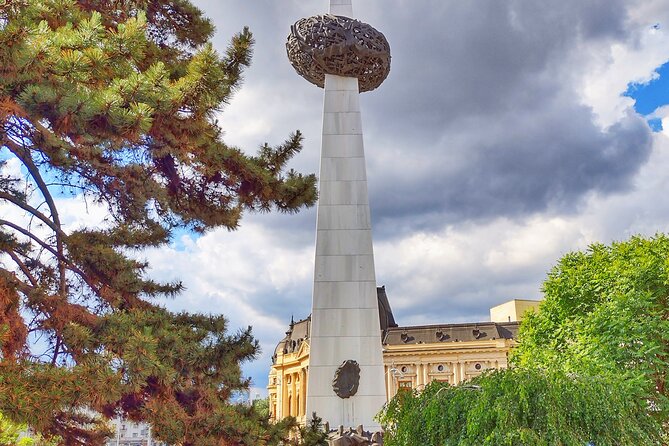
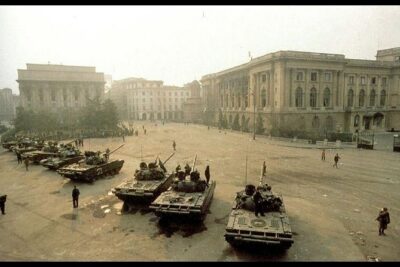
After about 15 minutes, you move to Piaka Revolukiei, the site where Ceausescu had his last speech in 1989. This is where the tour turns from architecture to turning points. You get about 45 minutes here, and the guide supports the story with pictures and video presentations from the Revolution days. That is a big deal, because it reduces the need for you to piece things together later from scattered sources.
One practical way to get the most out of this stop: ask about the timeline and how public spaces played a role. The guide is there to connect the event to what you are standing next to.
What to watch: this part can be emotionally heavy even when it is handled well. Keep your pace steady and do not feel you need to “power through” if you are feeling overwhelmed.
University Library, Royal Residence, and the Boulevard Between Eras
Next comes Biblioteca Centrala Universitara, a landmark built in eclectic style with support connected to King Carol I. The guide points out architect Paul Gottereau’s role, and you can also see King Carol I’s equestrian statue in front of the library. This is your lesson in how institutions advertised legitimacy and modernity through architecture.
Then you head toward Palatul Regal, the Royal Palace, specifically the winter residence of Romanian kings, dating to 1937. The story here connects directly to Queen Maria and her son, King Carol II, who had major influence over how the palace was realized. Even if you are not entering the palace, it is worth taking a moment to notice how royal spaces signal power through scale and placement.
Between these landmarks, the tour also includes a pass along the city’s most elegant avenue. The value of that stretch is simpler than it sounds. It helps you understand Bucharest’s layout, how grand buildings line up along important streets, and how “axis thinking” shaped what citizens experienced day to day.
Why this section matters: you see the shift in symbolism. Early on you are looking at civic culture and royal authority. Later, the political narrative becomes darker. The city does not change overnight, so these contrasts help you notice what remained, what adapted, and what was replaced.
Old Town Walk, Stavropoleos Monastery, and the Parliament Exterior
Old Town is next, with a walk through the center around cafes, pubs, and restaurants, plus a cluster of 19th century architecture. This is where you get a break from monument focus. You can reset your senses and enjoy the street rhythm of the area. It is also a good time to ask the guide for food and drink suggestions, because you are in the exact zone where those recommendations will make sense.
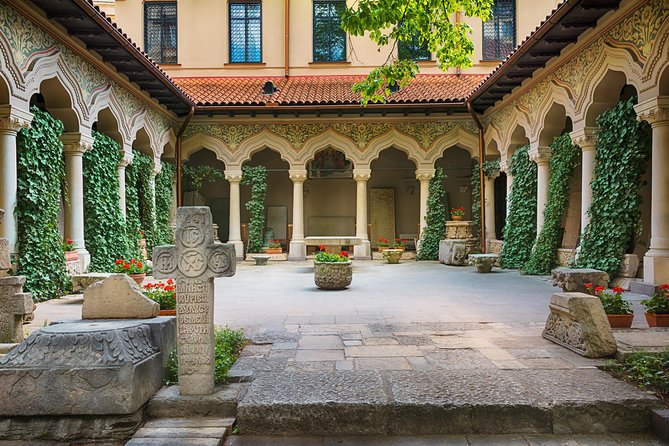
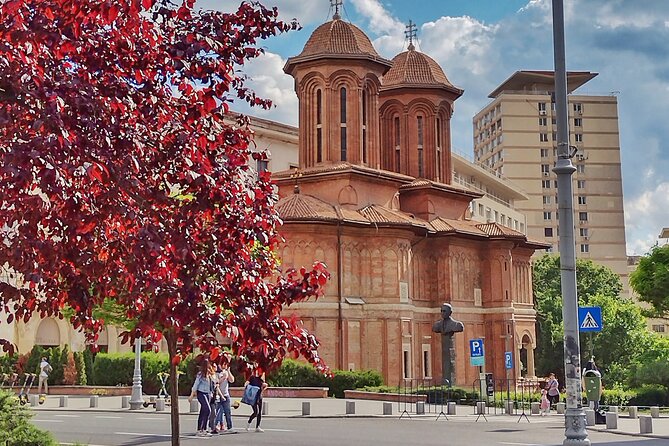
Then you reach Stavropoleos Monastery, described as one of the oldest churches in Bucharest, dating to 1724. This stop is short at about 10 minutes, but it has a different energy than the surrounding streets. It is the kind of place you might miss if you were only snapping photos of obvious landmarks. The guide’s job here is to help you slow down and read the site as more than a quick backdrop.
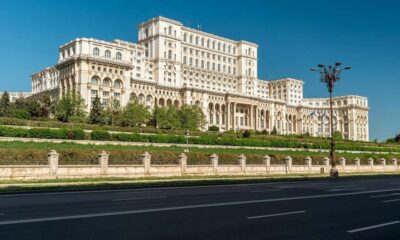
After that, you look at the Palace of the Parliament exterior. The construction began in 1984, and the guide explains why it became a symbol of the state’s obsession with scale. You will hear the famous comparisons, like the claim that its volume exceeds that of the Great Pyramid of Giza by about 2 percent. It is also described as the world’s third-largest administrative building. The point is not whether every measurement is perfectly phrased, the point is that this building was designed to dwarf everything around it, and you can feel that from the outside.
Consideration for this section: exterior viewing means you will not get the full museum-level experience of interiors here. If you want to go inside, plan that as a separate decision, because entrance fees are not included.
Macca Villacrosse Passage to Lipscani: Arcades and Street Life
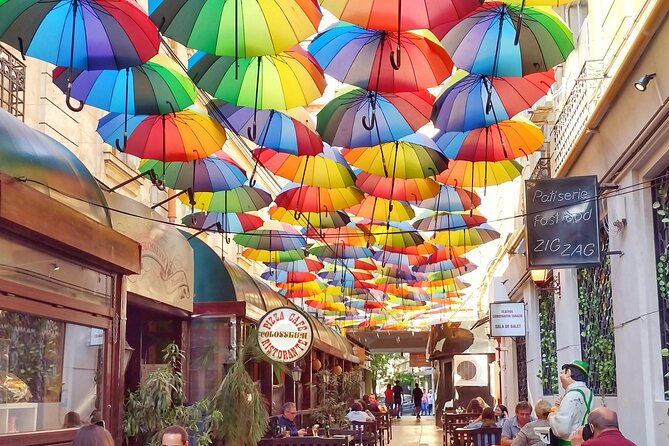
After the Parliament area, the tour shifts into charm and contrast. You visit Macca Villacrosse Passage, a covered passage with a glass roof. It is listed for about 5 minutes, and that time is about enough for you to appreciate the atmosphere and spot the hookah café vibe that fills the space.
Then comes Lipscani, an old street you walk along for about 10 minutes. This is Bucharest in mini-form: a mix of history references, storefront life, and street-level energy. It is also a practical stop because it anchors the Old Town area, helping you later figure out where you want to return.
Palatul CEC, Cărturești Carusel, and the Royal Museum Buildings
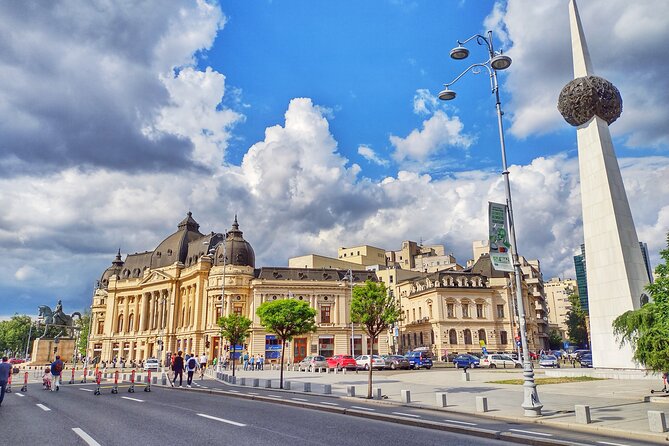
Next is Cărturești Carusel, a renovated bookshop that mixes browsing with Romanian-themed souvenirs and gifts. The stop is about 10 minutes, so you are not here to read every spine. You are here to get the feel of Bucharest’s modern retail culture layered onto an older setting.
Then you see Palatul CEC, a 19th century building full of statues. It gets around 5 minutes, but those statues are exactly the kind of detail that makes a night tour worth it. In the dark, highlights catch on sculpted stone, and you notice design choices you would miss in daylight crowds.
From there, the tour includes Muzeul Național de Arta al României, described here as the former Royal Palace. You get about 5 minutes. Again, think of this as “learn where to look next,” not “finish every museum.”
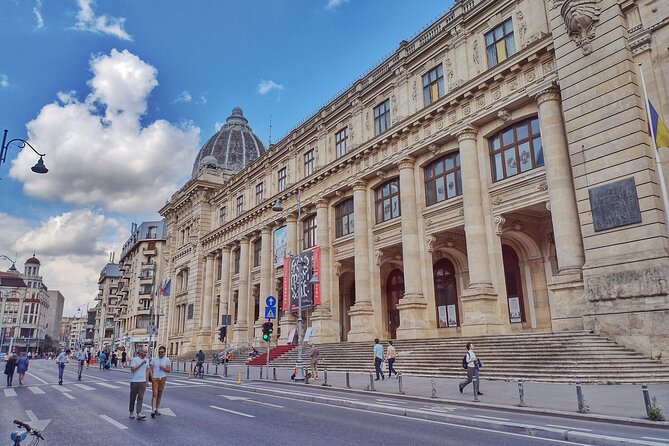
The walk also includes Muzeul National de Istorie a Romaniei, the former Post Office Palace, and Biblioteca Națională a României, listed as an iconic palace in the Old Town area. For these two, admission ticket is not included. That is your cue to decide on the spot (or later) whether you want to spend money for entry, based on your interests and how your evening is going.
My practical advice: when a museum is not included, take 2 minutes to read the exterior context and then decide. If you are still energized, you can return tomorrow and buy tickets. If you are tired, you have already gotten the architectural payoff.
Should You Book This Footprints of Bucharest Tour?
I think this is a great booking if you want a structured night introduction to Bucharest’s big themes: grand architecture, the Revolution story centered on 1989 and Ceausescu’s last speech, and the Old Town areas you can build a further evening around.
Book it if:
- You have limited time and want a 2 to 3 hour “greatest hits plus context” walk.
- You prefer a small group experience with more attention from the guide.
- You want practical guidance for where to eat and what to explore after the tour.
- You like the idea of seeing key monuments at night rather than sprinting through daylight.
Skip it or plan differently if:
- You know you will not handle weather changes well, since the experience requires good weather.
- You want deep museum time. This tour is more about the exterior, the storytelling, and smart orientation than long indoor visits.
- You are sensitive to heavier political topics, even when presented with visuals and clear pacing.
If you are unsure, do this: pick a time where you still have energy after. Wear comfortable shoes, and treat it as your evening map. Then use what you learned to choose where you go next.
FAQ
How long is the Footprints of Bucharest tour?
It runs about 2 to 3 hours.
What is the maximum group size?
The tour has a maximum of 8 travelers.
Is the tour offered in English?
Yes, the tour is offered in English.
Are entrance fees included?
Entrance fees are not included. Many listed stops are admission ticket free, but some museums have admission ticket not included.
Where do I meet, and where does the tour end?
You start at Strada Benjamin Franklin 2, București 030167, and you end at Piața Unirii, București, near the Old Town area.
What happens if the weather is bad?
The experience requires good weather. If it is canceled due to poor weather, you will be offered a different date or a full refund.
Newest Bucharest write-ups
- Half Day Tour in Bucharest
★ 5.0 · 1 review - Private transfer to BRASOV
★ 5.0 · 1 review - Bucharest: Capture the most Photogenic Spots with a Local
★ 5.0 · 1 review - Bucharest Private Custom Walking Tour with Guide (Private Tour)
★ 5.0 · 1 review - Transfer Bucharest to Constanta / Mamaia
★ 5.0 · 1 review - Uncover Transylvania: Private 2-Day Tour Bears & Medieval Wonders
★ 5.0 · 1 review - Private Day Trip to Peles Palace, Dracula’s Castle and Brasov
★ 5.0 · 1 review
Communist-Era Tours, compared.

Parliament, Ceausescu House & Village Museum Tour
Read our review →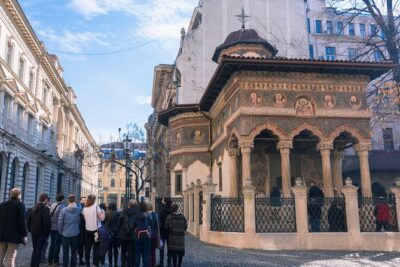
Bucharest Essential Tour: Old Town, Calea Victoriei & Communism
Read our review →
Communism in Bucharest – Landmarks, Museum & Communist Appetizers
Read our review →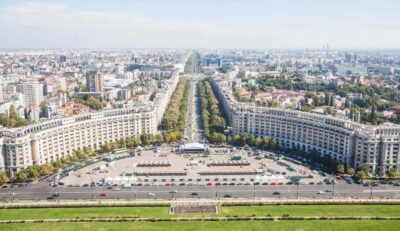
Palace of Parliament, Ceausescu House & Village Museum
Read our review →Browse the lists this tour appears in