
Reviewed · HISTORICAL TOURS
Guided Walking Tour of Historical Bucharest
Bucharest history is best on foot. This 3-hour walk strings together the city’s big stories, from old Wallachian roots to the shock of the Romanian Revolution. You’ll cover famous squares and famous buildings, but the guide also explains how the Cold War era changed what you see today.
I especially love the architecture switch-ups you get in one route, from Orthodox church scenes to grand Communist-era landmarks. I also like that you get real photo angles at the squares and boulevards, not just vague sightseeing.
One thing to consider, though: this is a lot of walking. If you’re sensitive to heat or you want a slower pace, bring water and plan your footwear carefully.
In This Review
- Key highlights you will feel on the ground
- Starting at Manuc’s Inn: a smart first anchor point
- St Anton Orthodox Church and the Wallachian coronation connection
- Old Princely Court ruins: Vlad’s shadow in the Old Town
- Unirii Square fountains and Bulevardul Unirii: where the city centers itself
- Palace of Parliament viewpoint: the moment Bucharest gets serious
- Piaka Constitukiei and nearby churches, built for public life
- The CEC Palace and Victoria Avenue shops: business history meets daily streets
- Old-center lanes and the 500-year-old feel
- Passage Macca and Villacrosse: Bucharest’s hidden connectors
- National Bank grandeur and University Square with Alexandru Ioan Cuza
- Suțu Palace: former home turned Bucharest history museum
- Colțea Hospital and church, built in 1888
- National Theatre exterior pass and Biserica Kretzulescu
- The 1989 revolution route: balcony, headquarters, and public memory
- Memorial of Rebirth and the 25-meter scale
- Military Circle and Sărindar Fountains to close the loop
- Price value for a 3-hour, pickup-included walk
- Pace, language, and what can affect your comfort
- Who this tour suits best
- Should you book it?
- FAQ
- How long is the Guided Walking Tour of Historical Bucharest?
- How much does the tour cost?
- Is pickup included?
- Where does the tour start and end?
- What language is the tour offered in?
- Is this a private tour?
- Is the tour good for kids?
- What about walking ability or mobility?
- Are service animals allowed?
- Is weather a factor?
- What is the cancellation policy?
Key highlights you will feel on the ground
- 3 hours, private group feel with pickup and drop-off back near Manuc’s Inn
- Old Bucharest to Communist Bucharest in one route, with the political context kept visual
- Big photo stops at Unirii and the Palace of Parliament area, plus fountains and memorials
- Passages and palaces (like Macca and Villacrosse, plus Suțu Palace) that add texture beyond the postcards
- A guide-led story rhythm that connects each place to what came before
- Many listed stops are Admission Ticket Free, so you spend time looking, not waiting
More Guided Walks in Bucharest
- Bucharest: City Highlights Guided Walking Tour★ 4.9 · 1,482 reviews
- Bucharest: Communism and History Guided City Walking Tour★ 4.9 · 918 reviews
- Bucharest Highlights Walking Tour★ 5.0 · 469 reviews
- Bucharest: Hidden Markets Walking Tour with Tastings★ 4.9 · 329 reviews
Starting at Manuc’s Inn: a smart first anchor point
You begin at Hanul lui Manuc, also called Manuc’s Inn, right in the Old Centre near Strada Franceză. It’s a fitting start because the tour doesn’t pretend Bucharest began in one era. The guide ties the inn’s story to the city’s older trading and hospitality life, so you start with a human scale.
This is also practical. When the tour ends, you finish back at the same meeting point, so you don’t end up wandering through unfamiliar streets at the end of your trip. If you’re doing Bucharest as a first-time stop, that matters.
St Anton Orthodox Church and the Wallachian coronation connection
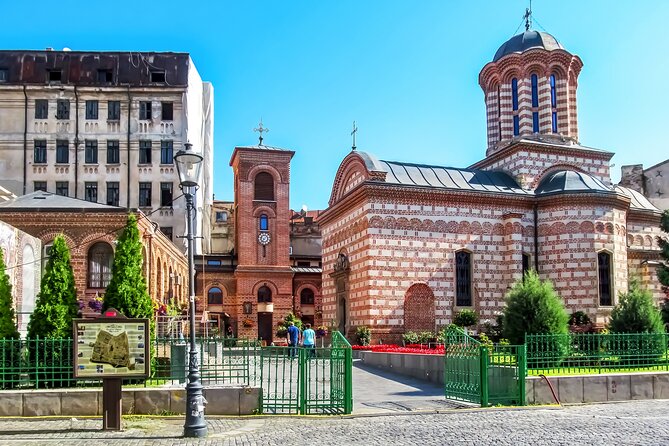
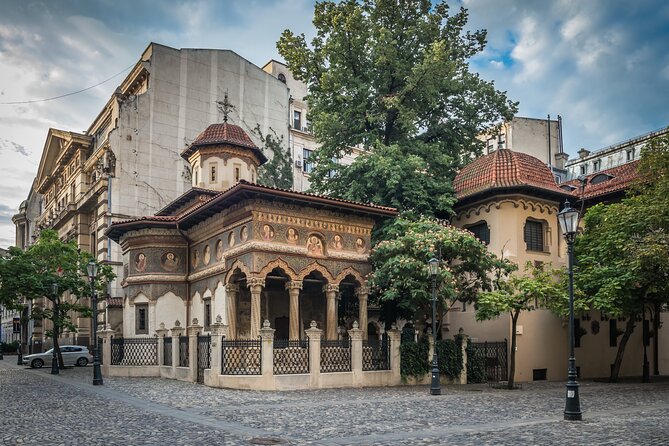
Next, you head toward St Anton Orthodox Church in the heart of Bucharest. The standout detail here is that it served as a former coronation church for Wallachian rulers. That single fact turns a normal stop into something you can actually picture: power passing through religion, pageantry, and public ceremony.
In a city where eras keep piling up, places like this help you understand why so many Romanian landmarks are not just pretty buildings. They are built-in reminders of who had authority, and how they showed it.
Old Princely Court ruins: Vlad’s shadow in the Old Town
Then you reach the Old Princely Court area and see the ruins of the Old Princely Palace, linked to Wallachian rulers. This stop is especially strong if you’ve heard of Vlad the Impaler. The tour connects that legend to place, including the idea that Vlad had ties to the palace.
You don’t need to be a medieval history fan to enjoy this moment. What hits is the contrast: ruins that still sit in the middle of modern Bucharest life. And because the stop notes Admission Ticket Free, it stays easy to fit in without adding extra ticket friction.
More History Tours in Bucharest


Unirii Square fountains and Bulevardul Unirii: where the city centers itself
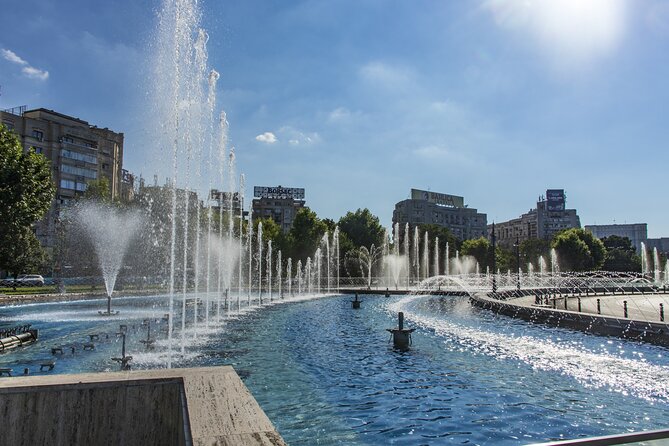
Now you move into the heart of Bucharest around Piața Unirii. The fountains are refurbished and the setting is full of clear photo opportunities. This is also where the guide’s explanation helps you see the city as layers, not as random landmarks.
From there, you go along Bulevardul Unirii, described as the former Boulevard of Socialist Victory. That detail is key to the tone of the whole walk. You start to notice that some streets were designed to sell an ideology, and the present-day look is the result of what stayed, what was altered, and what was replaced.
Palace of Parliament viewpoint: the moment Bucharest gets serious
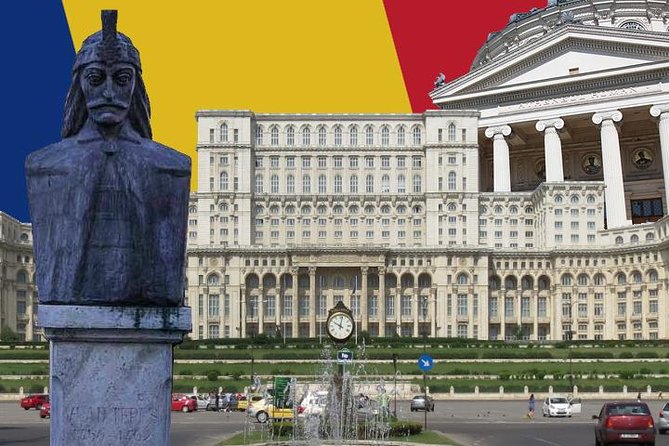
When the tour reaches the Palace of Parliament area, it shifts gears. You’ll look over Unirii Boulevard toward the city center, with excellent photo angles from the outside viewpoints. This is one of those places where the architecture alone tells you there was a big political project behind it.
And the guide’s talk about Ceaușescu’s dictatorship and the Cold War era makes the building more than a photo. It becomes a symbol of how power expressed itself in stone, scale, and control of public space. If you come to Bucharest wanting to understand why the city looks the way it does, this is one of the payoff stops.
Piaka Constitukiei and nearby churches, built for public life
Next you’ll be at Piața Constituției, directly in front of the parliament buildings. The location is almost designed for framing photos. You get a good sense of how wide the civic spaces are and why large-scale monuments matter in Bucharest’s public life.
In this segment, the tour also points out a church built in 1724, and later includes a pause at Biserica Kretzulescu. These religious stops add a different texture to the walk. They remind you that even when politics turns huge, daily life still circles around churches, community, and long-term tradition.
The CEC Palace and Victoria Avenue shops: business history meets daily streets
After the big civic landmarks, the tour threads through Bucharest in a more everyday way. You’ll hear about the CEC Palace, a building with its own story in Bucharest’s economic life. Then you take a walk along part of Victoria Avenue, lined with shops.
This part is useful for two reasons. First, it breaks the momentum, so your legs get a short breather between major sights. Second, it helps you picture how Bucharest functions now, not just how it looked when politics was the main character.
Old-center lanes and the 500-year-old feel
The tour then pulls you into the old center, described as culture and history stretching back more than 500 years. This is where the city starts to feel less like a route and more like a place you could wander for hours.
As a practical tip, this is also where you benefit most from a guide. The streets and passages can feel confusing if you’re learning the city layout on your own. A good guide keeps the route logical, so you understand where you are and why you’re moving.
Passage Macca and Villacrosse: Bucharest’s hidden connectors
You enter Passage Macca and Villacrosse and hear about its past. Passages like this are a favorite kind of stop for walking tours because they feel like secret shortcuts, even if you’re just passing through with a group.
What makes it worthwhile is the contrast. You’re in a narrow space, then the guide connects it back to the city’s bigger historical shifts. It makes Bucharest feel stitched together, not chopped into separate eras.
National Bank grandeur and University Square with Alexandru Ioan Cuza
As you keep moving, you reach the grandeur of Romania’s National Bank, followed by University Square. At University Square, you’ll see the oldest and largest university in Bucharest, built by Alexandru Ioan Cuza and founded in 1864.
This is a strong “why Bucharest educated itself” moment. It’s easy to see grand buildings and just admire them. But the guide’s framing helps you understand how institutions shaped the city and how education, culture, and politics influenced each other.
If you’re the type who likes taking photos of facades, bring your phone camera battery. This is one of those stretches with standout building lines.
Suțu Palace: former home turned Bucharest history museum
Next, you pause at Suțu Palace, which serves as the history museum of Bucharest. The tour also points out it was the former residence of Costache Suțu.
Even if you do not go inside on this walk, the stop matters because it explains how homes of influential people became public institutions. That theme keeps showing up throughout the route, from palaces to squares to memorials. Bucharest keeps repurposing power structures into heritage.
Colțea Hospital and church, built in 1888
Colțea Hospital and church is one of the iconic center-city stops on the walk. The tour notes it was built in 1888, and it pairs the medical and religious functions in one visual anchor.
This is another smart contrast stop. After the huge politics landmarks, you return to a story about care, civic responsibility, and community infrastructure. It broadens the picture so Bucharest isn’t only told through rulers and regimes.
National Theatre exterior pass and Biserica Kretzulescu
You pass by the National Theatre of Bucharest, an iconic building described as having many changes to its design over its short history. That detail is worth paying attention to because it signals something about the city itself: repeated reinvention, shifting tastes, and changing priorities.
Then you stop at Biserica Kretzulescu, described as beautiful with a fascinating history. This is the part of the tour that feels calmer. The storytelling still matters, but the pace of the setting lets you absorb what you’re seeing.
The 1989 revolution route: balcony, headquarters, and public memory
One of the strongest sections is the walk through the area where the famous revolution of 1989 started, with memorials that commemorate the life-changing events. The guide points out multiple landmarks connected to that moment.
You’ll hear about the balcony where Nicolae Ceaușescu made his final speech. You’ll also pass the former headquarters of the Communist party, the Monument of National Rebirth, King Carol I’s equestrian statue, the University library, and more.
This is emotionally heavy content, but it’s also one of the most meaningful ways to understand Bucharest. You’re not reading about history in a book. You’re standing near the physical locations where political drama became national change. If you like history that has coordinates, not just dates, this section hits hard.
Memorial of Rebirth and the 25-meter scale
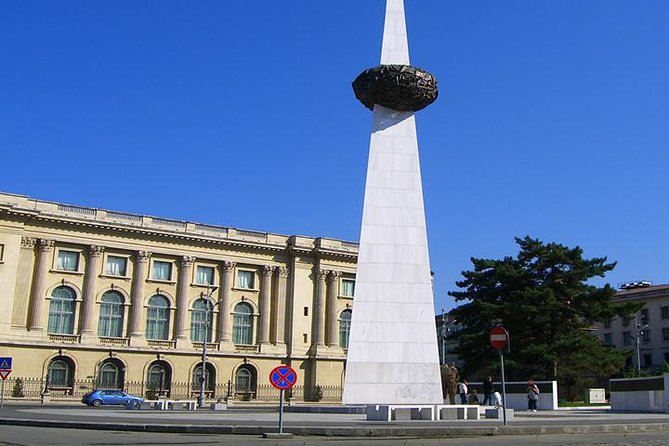
Near the end, you stop at the Memorial of Rebirth, a 25-meter monument commemorating struggles and victims of the Romanian Revolution of Christmas 1989. The tour gives you time for photos and a clearer sense of scale.
This is also where the route feels complete. Earlier you saw grand civic and institutional buildings. Now you see a memorial designed to make loss and transformation impossible to ignore.
Military Circle and Sărindar Fountains to close the loop
Finally, you reach the Military Circle and Sărindar Fountains. The tour describes the site as built for the people of Bucharest by the people of Bucharest over 100 years ago, with beautiful gardens and a stunning historical building.
This ending choice is smart. It gives you a “walk-off” moment with scenery and calmer streetscape energy, after the memorial-heavy emotional peak. It’s a nice way to cap a day that goes from palaces and squares to revolution memory.
Price value for a 3-hour, pickup-included walk
The price is $30.77 per person for about 3 hours. At that rate, what you’re really buying is time with a guide who connects architecture to the social and political shifts that shaped the city.
Also, the tour includes hotel pickup and drop-off back near the meeting point area. For a walking route that covers major parts of central Bucharest, that convenience is not small.
Finally, the route includes several stops marked Admission Ticket Free, which helps you keep the total cost predictable while still seeing meaningful places.
Pace, language, and what can affect your comfort
This is a walking tour with moderate physical fitness required. A lot of people tend to underestimate how many steps three hours can mean in a city center, especially if you’re stopping for photos often.
From the experience tone, it sounds like the pace is not a sprint, and guides often keep things animated and story-driven. Still, plan for the walk to run around the full time window, and in some cases it can go a bit longer if questions and details run.
Language is English-speaking, but like any guided experience, clarity can vary by guide day and group size. If you prefer very fast, precise explanations, you may want to bring one or two specific questions so you can steer the discussion.
Who this tour suits best
You’ll love this tour if you want:
- A first-time orientation to Bucharest that explains why different buildings look the way they do
- Lots of photo stops that are tied to actual stories, not random sightseeing
- A route that connects the city’s old foundations to Ceaușescu-era and Cold War impacts
You might not love it as much if:
- You dislike political context. The tour talks about dictatorship, the Cold War, and the 1989 revolution through the city’s landmarks.
- You want a slow walk with minimal discussion. The focus is story and architecture, so you’ll spend plenty of time learning.
Should you book it?
Yes, if your goal is a strong, story-backed overview of Bucharest in a short window. The route is well designed for getting your bearings fast: you start at Manuc’s Inn, hit the central squares and the Palace of Parliament area, then you end on fountains and gardens.
My rule of thumb: book it early in your stay. Then you can use what you learned to choose the best next neighborhoods to wander on your own.
If you want a smoother experience, wear comfortable shoes, carry water, and come ready for a guide-led mix of architecture and 20th-century history. That combination is exactly what makes this walk worth it.
FAQ
How long is the Guided Walking Tour of Historical Bucharest?
The tour runs for about 3 hours.
How much does the tour cost?
The price is $30.77 per person.
Is pickup included?
Yes. Hotel pickup and drop-off are included, with pickup details given outside the main entrance of Manuc’s Inn.
Where does the tour start and end?
It starts at Manuc’s Inn (Hanul lui Manuc, Str. Franceză 62) and ends back at the meeting point.
What language is the tour offered in?
The tour is offered in English.
Is this a private tour?
Yes. It is private, meaning only your group will participate.
Is the tour good for kids?
Children must be accompanied by an adult.
What about walking ability or mobility?
Travelers should have a moderate physical fitness level.
Are service animals allowed?
Yes. Service animals are allowed.
Is weather a factor?
Yes. The experience requires good weather. If it’s canceled due to poor weather, you’ll be offered a different date or a full refund.
What is the cancellation policy?
You can cancel for free up to 24 hours in advance for a full refund. If you cancel less than 24 hours before the start time, you will not receive a refund.
Newest Bucharest write-ups
- Private transfer to BRASOV
★ 5.0 · 1 review - Half Day Tour in Bucharest
★ 5.0 · 1 review - Bucharest: Capture the most Photogenic Spots with a Local
★ 5.0 · 1 review - Bucharest Private Custom Walking Tour with Guide (Private Tour)
★ 5.0 · 1 review - Uncover Transylvania: Private 2-Day Tour Bears & Medieval Wonders
★ 5.0 · 1 review - Transfer Bucharest to Constanta / Mamaia
★ 5.0 · 1 review - Private Day Trip to Peles Palace, Dracula’s Castle and Brasov
★ 5.0 · 1 review
Historical Tours, compared.


Roma Culture, Realities and Slavery History, Walking tour
Read our review →
Bucharest Jewish Heritage | Holocaust Memorial | Private Car Tour
Read our review →
Private Bucharest: History & Food with Traditional Meal
Read our review →Historic Gems Sighișoara, Rupea and Viscri Day Tour
Read our review →
Browse the lists this tour appears in